| Home | Housing | Feeding | Requirements | Breeding | Biology | Books & Links |
 Caudata.org

Housing Axolotls in CaptivityGeneral InfoThe Requirements Page and Health Page discuss several important points that are mentioned on this page. For information regarding the housing of tiger salamanders and metamorphosed axolotls, click that link. Axolotls are not demanding in respect to their accommodation. It's important to bear in mind that an adult axolotl can reach a size from 18 to 35 cm in length (7-14 inches). Laboratories prefer to use minimalistic containers that barely allow the animals to turn around, like fish bowls. Each one is used to house a single animal, or a few are housed together in a container that approximates to a 45 cm long aquarium (18 inches). For the enthusiast, the accepted minimum size would be a 45 cm long aquarium (US 10 gallons) for one adult. The Simple AquariumShown below is an example of a simple setup for one adult axolotl.
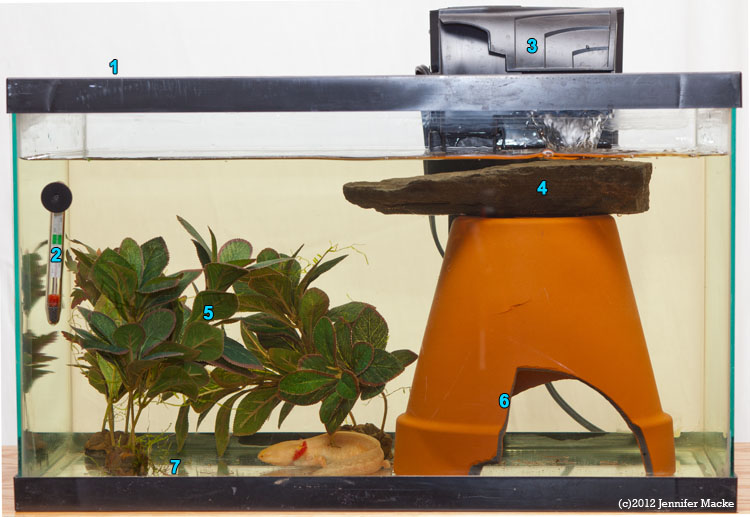
This is an aquarium of dimensions 50 cm long x 25 cm wide x 25 cm tall (20 x 10 x 10 inches; standard 10 gallons). It has no lighting, but does normally have a lid to prevent leaping. The hides consist of a pot and artificial plants. The filter is a hang-on-back waterfall filter, and the outflow is dispersed by a rock to prevent a current. No bottom substrate is used. The Advanced AquariumFor multiple axolotls, a larger tank is required. Shown below is an attractive example that could easily house 6 adult axolotls. At the time of this photo, it contained 12 juvenile axolotls.
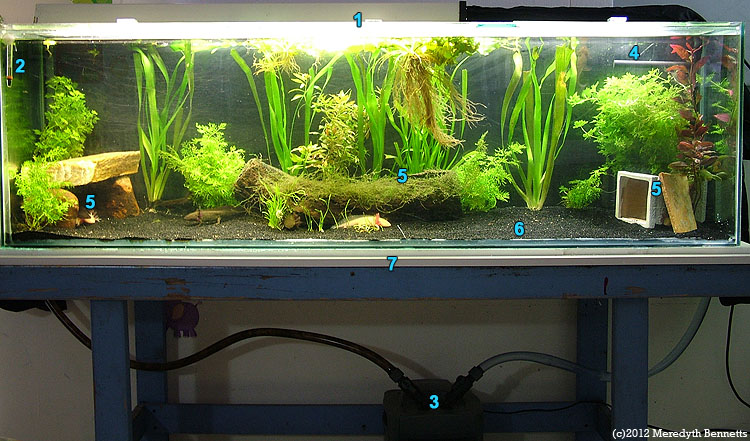
This is an aquarium of dimensions 150 cm long x 35 cm wide x 45 cm tall (5 ft x 14 in x 18 in). It has fluorescent lighting and glass lids. Hides consist of rocks, pottery, driftwood, and live plants (ambulia, water sprite, valls, liliopsis and java moss). The filter is an under-tank canister. The filter intake and outflow are on opposite ends of the tank to improve filtration. The outflow is dispersed by a spray bar to reduce stress to the axolotls. The bottom substrate is fine black sand (grain size 1 mm or smaller). An aquarium this size weighs over 400 kg (800 lb); large aquariums need a very sturdy support underneath. A layer of foam under the tank will help to even out any irregularities in the support. FiltrationFiltration is not essential for axolotls, provided you're willing to change the water very frequently. Most hobbyists prefer to include a filter, and there are a number of options, including under-gravel filters, internal power filters, external "hang-on-the-tank" filters, and canister filters. I prefer the last type, but it is also the most expensive option. Axolotls excrete a lot of waste. This is mainly in the form of ammonia (NH3). Ammonia is a very toxic substance in its unionised form, NH3, but this is in constant equilibrium with the ionised form NH4+, and through the process of nitrification, it is converted into the less harmful substance nitrite (NO2-). Other bacteria then convert this into the much more benign substance nitrate (NO3-). These two processes comprise the most important aspects of what is known as biological filtration. Nitrate is a source of fixed nitrogen (i.e., not Nitrogen gas, N2) for plants and fungi. Live plants, if included in the tank, will consume the nitrate generated from a good filtration system. I discuss water quality and chemicals in more detail on the Requirements Page. In my years of experience with aquarium filters and axolotls, I have found that it is important to choose a filter that is correctly sized for filtering the aquarium's water volume. A large filter is not suitable for a small tank and will usually create far too much water flow in the tank. This is possibly the biggest cause of stress-related disease in axolotls. Obviously the tank shouldn't be like a river, but the actual water turnover through the filter shouldn't be much beyond what is required. Too little "biological filtration" - roughly surface area for bacteria growth in the filter - is also a bad idea. 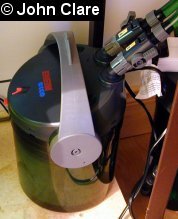
The filter shown at right is an Eheim "Ecco" 2231. To my knowledge, it's their smallest canister filter, designed for aquariums from 60 to 100 litres (13-22 Imp gal, 11-18 US gal). It has a turnover of 300 litres per hour (66 Imp gal, 50 US gal). I've turned this down to about 150 litres per hour. As shown in the aquariums above, it is important to disperse the outflow from the filter. This can be accomplished by means of a spray bar, or the careful placement of aquarium decor to interrupt the flow of water. Whether you use a power filter (internal or external), an under-gravel filter, or something above-board is up to you, but there are a few more things to keep in mind. If you don't use gravel, you may need a slightly larger filter to provide more surface area on which bacteria can grow. These bacteria will make up the biological side of your filter, and need to have a sufficient surface area on which to grow in order to meet the demands made on them. You can buy filter media that is porous, and therefore has a surprisingly large surface area for bacteria. Eheim's "Ehfi-Substrat" is a sintered glass that performs this function. I use it in combination with the 2231's standard filter pads. Other companies like Fluval also supply similar filter media. Finally, remember, you should "age" the tank for at least two weeks after filling it with water, connecting up the filter, and before adding many axolotls. The addition of a single small axolotl after initial setup will aid development of the bacteria on the filter media, in preparation for the addition of your other axolotls. Obviously, water should be dechlorinated with aquarium dechlorinator (or better still, left to stand for several days). More on water on the Requirements Page. Due to my experience (and impatience!), I rarely age my own aquariums. Instead, I add my axolotls almost immediately, but I clean the tank and do a partial water change daily for two weeks. For the following few weeks or so I make slightly less regular water changes, in order to give the filter a chance to build up to full capacity. Once your filter is established for a month or two, continue to conduct regular, if less frequent, water changes. I recommend changing between 10 and 20 percent of the tank's water volume every week, depending on how densely it is populated. I also advise that you vacuum up any uneaten food and unfiltered waste after every feeding (or at least twice per week), and replace the water removed. A small siphon is ideal for this purpose. SubstratesAxolotls have a nasty habit of getting normal aquarium gravel in their mouths, and occasionally swallowing it. This can be fatal because the gravel can cause blockages in the gut. It's rare, but not rare enough to be worth risking. In short, if you use normal aquarium gravel you risk killing your axolotl. Gravel-swallowing can be avoided by using gravel that is very large (larger than the animal's head). If you use an external filter like me, stones tend to let debris accumulate in the tank, and so the filter has a hard time keeping the the bottom clear of solids. Since axolotls are messy, the filter may difficulty dealing with the excrement and waste food that accumulate in gravel. If you do use gravel, it's advisable to siphon the waste out of it - a "gravel cleaner" is ideal for this purpose. As another alternative, fine sand is also a good substrate, as it will not clog the digestive tract if ingested. It has been my experience that axolotls can't "grip" the bottom of a glass tank. Some people feel that this is stressful for the animal. Plastic tanks don't suffer from this problem so much because no plastic is as smooth as glass. Other alternatives for substrate include flat pieces of slate covering a large portion of the tank bottom, gravel that is glued into the bottom of the tank using aquarium sealant, or a simple layer of dark-colored aquarium sealant in the bottom of the tank. Aquarium sealant should always be allowed to cure thoroughly before water is added to the tank. Lids and LightingAxolotls do not require any specific lighting, but lighting is essential for a display aquarium, and a must for an aquarium that contains live plants. Many successful axolotl enthusiasts use ordinary aquarium lighting - typically, a "hood" with a fixture for a fluorescent aquarium bulb. A lid is required, regardless of the type of lighting used. Axolotls cannot climb, but they have been known to leap out of their tank, often with fatal consequences. If a mesh lid is used, this may help to keep water temperature lower by allowing evaporation. The addition of a fan blowing on the water can further reduce water temperature significantly. TemperatureAlways use an aquarium thermometer. The water should be kept between 10 and 20 °C (50-68 °F). Anything below about 10 °C leads to more sluggish activity and a lower metabolism. At lower temperatures, axolotls will eat less frequently. They may even refuse food altogether. It should be noted though that axolotls don't "hibernate" in the sense applied to most animals - they simply have reduced metabolism. Above 24 °C, axolotls become stressed, and such warm conditions will usually result in disease if sustained for a several days. Temperature fluctuations of more than a few degrees Celsius in a 12 hour period (between night and day) can also be stressful. It's a good idea to keep the temperature stable on a day-to-day basis, even if it varies over the year with the seasons. A heater is rarely ever necessary. If needed, standard aquarium heaters used in fish aquariums are ideal for axolotl tanks. A heater set at 18 °C (65 °F) is a good idea in a room that's very cold, particularly if there is a risk of freezing. More often, the hobbyist is faced with the problem of keeping the aquarium cool enough during warm weather. While whole-room air conditioners and aquarium chillers are expensive, they are the most-effective ways to significantly decrease the temperature of aquarium water. Read more about cooling methods for aquariums over at Caudata Culture. DecorationsThe addition of plants, caves, pipes, etc., gives axolotls an added sense of security, as well as being attractive to the human eye. Live plants are a challenge, as axolotls will tend to uproot them. However, floating plants do well, and some plants can be rooted in small pots or in places where the axoltls are less likely to disturb them.
While not demanding, axolotls deserve to be well cared for, just like any other animal. Good luck with your aquarium plans. If you have questions about your proposed setup, why not talk to the people in the Axolotl area of Caudata.org's Forum? You will also find many ideas for axolotl aquaria there. Unless cited in the Acknowledgements, all text and images are ©1998-2019 John P. Clare. All Rights Reserved. Bookmark Axolotl.org with:
What are these? | ||||||||||||||||||||||||

 reddit
 Facebook